Chlorine has long reigned as the king of water disinfection, celebrated for its ability to zap pathogens and keep our drinking water safe. Yet, its environmental baggage—think toxic byproducts and ecosystem disruption—has sparked a quest for greener alternatives. As water treatment plants evolve to meet sustainability goals, a range of substitutes and innovative products are stepping into the spotlight. In this blog, we’ll explore why chlorine’s dominance is being challenged, break down the top eco-friendly alternatives with detailed data, and recommend specific products to help water treatment facilities make the switch.
The Chlorine Conundrum
Chlorine’s superpower lies in its oxidizing prowess, annihilating bacteria, viruses, and other nasties with ruthless efficiency. Globally, it’s used in about 98% of water treatment plants, often as chlorine gas, sodium hypochlorite (liquid bleach), or calcium hypochlorite (solid granules). However, when chlorine reacts with organic matter, it forms disinfection byproducts (DBPs) like trihalomethanes (THMs) and haloacetic acids (HAAs), which are linked to health risks like cancer at high exposure levels. The U.S. EPA caps chlorine residuals at 4 mg/L (parts per million) to mitigate these risks, but even within limits, chlorine discharged into waterways can harm aquatic life. With sustainability on the agenda, let’s dive into the alternatives that promise cleaner water and a healthier planet.
Top Substitutes for Chlorine Dosing
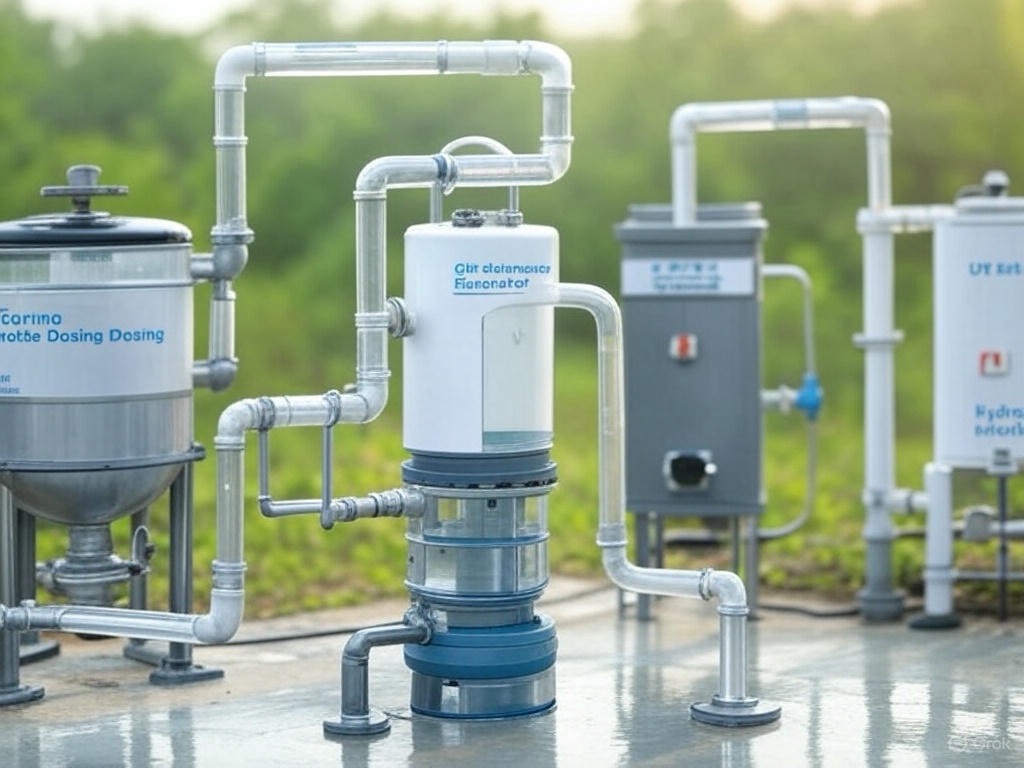
Here’s a detailed rundown of the leading alternatives, complete with technical specs, pros, cons, and product recommendations:
- Ozonation
How It Works: Ozone (O₃) is a triatomic form of oxygen generated on-site by passing dry air or oxygen through high-voltage electrodes. It’s a potent oxidizer, breaking down pathogens and organic compounds in seconds before decomposing into harmless oxygen.
Technical Data:- Oxidation potential: 2.07 V (vs. chlorine’s 1.36 V).
- Typical dosage: 1–5 mg/L, depending on water quality.
- Contact time: 5–15 minutes for effective disinfection.
Pros: No harmful residuals, eliminates taste/odor issues, effective against chlorine-resistant pathogens like Cryptosporidium.
Cons: High capital cost (~$50,000–$500,000 for mid-sized plants), energy-intensive (10–15 kWh/kg of ozone), no residual disinfection.
Product Recommendation: - Ozonia M by Veolia: A modular ozone generator with capacities from 0.5 to over 100 kg/h. Features advanced dielectric technology for efficient ozone production. Ideal for medium to large plants transitioning from chlorine.
Use Case: The Los Angeles Department of Water and Power uses ozonation at its Aqueduct Filtration Plant, treating 600 million gallons daily with zero THM formation.
- Ultraviolet (UV) Disinfection
How It Works: UV light at 254 nm wavelength penetrates microbial cells, scrambling their DNA to prevent reproduction. Systems use low- or medium-pressure mercury lamps housed in quartz sleeves.
Technical Data:- Dose range: 20–40 mJ/cm² for 99.9% pathogen inactivation.
- Flow rates: Up to 10,000 m³/h for large-scale units.
- Lamp lifespan: 8,000–12,000 hours.
Pros: Chemical-free, no DBPs, low operating cost (~$0.02–$0.04/m³).
Cons: No residual protection, requires clear water (turbidity Product Recommendation: - TrojanUV3000Plus by Trojan Technologies: Delivers up to 12,000 m³/h with automated lamp cleaning and energy-efficient design. Perfect for municipal plants pairing UV with a secondary residual disinfectant.
Use Case: The Netherlands’ PWN Water Supply Company uses UV to treat 120 million liters daily, reducing chlorine reliance by 80%.
- Hydrogen Peroxide (H₂O₂)
How It Works: A mild oxidizer, hydrogen peroxide releases hydroxyl radicals (OH•) when activated (e.g., by UV or catalysts), attacking microbial cell walls. Often used in advanced oxidation processes (AOPs).
Technical Data:- Concentration: 3–50% solutions, typically 10–20 mg/L dosing.
- Oxidation potential: 1.78 V (boosted to 2.8 V with UV).
- Decomposition: Breaks down into water and oxygen.
Pros: Environmentally benign, synergistic with UV, no toxic residuals.
Cons: Higher doses needed standalone (~50 mg/L), less effective against some viruses.
Product Recommendation: - Peroxal by Solvay: A stabilized 35% H₂O₂ solution optimized for water treatment. Pair with a UV system like the atg UV Systems LX Series for AOP efficiency.
Use Case: Small-scale plants in Europe use H₂O₂-UV combos to treat groundwater, achieving 4-log pathogen reduction with minimal footprint.
- Chlorine Dioxide (ClO₂)
How It Works: A selective oxidizer, ClO₂ penetrates microbial membranes without halogenating organics, reducing DBP formation. Generated on-site from sodium chlorite and an acid.
Technical Data:- Dosage: 0.1–2 mg/L for disinfection.
- Oxidation potential: 0.95 V ( gentler than chlorine but highly effective).
- Residual stability: Up to 48 hours in distribution systems.
Pros: Fewer DBPs than chlorine, effective at wide pH range (6–10), safer handling than chlorine gas.
Cons: On-site generation complexity, higher cost (~$0.05–$0.10/m³ vs. chlorine’s $0.02/m³).
Product Recommendation: - Activ-Ox by Feedwater: A compact dosing system producing ClO₂ instantly via a reaction tee. Capacities from 1 to 1,000+ m³/day, ideal for small to medium plants.
Use Case: The City of Florence, Italy, switched to ClO₂, cutting THM levels by 70% while maintaining residual disinfection.
- Electrolyzed Water (Hypochlorous Acid)
How It Works: Electrolysis of saltwater (NaCl + H₂O) generates hypochlorous acid (HOCl), a natural disinfectant, on-site. Systems use membrane cells to separate acidic and alkaline streams.
Technical Data:- HOCl concentration: 50–200 mg/L.
- pH range: 5–6.5 (optimal for disinfection).
- Energy use: 1–2 kWh/m³.
Pros: Sustainable (no chemical transport), minimal residuals, scalable.
Cons: Limited to smaller systems, still produces trace chlorine compounds.
Product Recommendation: - EcoLyzer by Electrolytic Technologies: Generates up to 500 L/h of HOCl with adjustable concentrations. Suited for rural or decentralized plants.
Use Case: Japan’s water facilities use electrolyzed water for secondary disinfection, reducing chemical storage needs by 90%.
Emerging Technologies and Products
- Biofiltration:
Details: Employs microbial communities in sand or carbon filters to degrade organics. Dosage: Minimal chlorine (0.1–0.5 mg/L) or UV as backup.
Product: BIOPUR by Veolia—a biofilter system enhancing natural purification.
Data: Removes 50–80% of organic carbon, cutting chemical use by half. - Nanotechnology:
Details: Silver nanoparticles or TiO₂ photocatalysts kill pathogens via surface reactions. Dosage: 0.1–1 mg/L.
Product: NanoClean by NanoSun—TiO₂-based modules for UV-assisted disinfection.
Data: 99.99% bacterial reduction in lab tests, still scaling up. - Solar Disinfection (SODIS):
Details: UV-A and heat from sunlight in PET bottles disinfect small batches. Cost: $0.
Product: Basic plastic bottles—no fancy tech needed!
Data: 4–6 hours exposure achieves 3-log reduction in emergencies.
Comparative Data Snapshot
Method Dosage (mg/L) Cost ($/m³) DBP Formation Residual Effect Energy Use (kWh/m³) Chlorine 2–4 0.02–0.03 High Yes 0.01–0.02 Ozone 1–5 0.10–0.20 None No 0.05–0.15 UV N/A (mJ/cm²) 0.02–0.04 None No 0.03–0.06 H₂O₂ (with UV) 10–20 0.05–0.10 None No 0.04–0.08 ClO₂ 0.1–2 0.05–0.10 Low Yes 0.02–0.05 Electrolyzed Water 50–200 (HOCl) 0.03–0.06 Low Yes 0.01–0.02
Implementation Tips
- Hybrid Systems: Pair UV or ozone with low-dose ClO₂ (e.g., 0.2 mg/L) for residual protection in distribution networks.
- Water Quality Matters: Test turbidity and organic load—UV and H₂O₂ need clear water to shine.
- Cost-Benefit Analysis: For small plants (
The Road Ahead
Switching from chlorine isn’t just about dodging DBPs—it’s about future-proofing water treatment. Products like Ozonia M, TrojanUV3000Plus, and Activ-Ox are paving the way, backed by data showing reduced environmental impact and comparable (or better) pathogen control. While upfront costs can sting, long-term savings in health, compliance, and ecosystem protection make the case compelling. Imagine a world where every water plant balances safety with sustainability—those ripples could turn into a tidal wave of change.
What’s your take? Ready to pitch one of these solutions to your local water authority?
 Water Solutions You Can Trust
Leave a comment